

Matthew 12:11–12: “He said to them, ’Which one of you who has a sheep, if it falls into a pit on the Sabbath, will not take hold of it and lift it out? Of how much more value is a man than a sheep! So it is lawful to do good on the Sabbath.’”
4Q265 f6:5–7 (from the dead sea scrolls): “Let no one raise up an animal which has fallen into the water on the Sabbath day. But if it is a man who falls into the water [on] the Sabbath [day,] one shall extend his garment to him to pull him out with it.”
Rules for the Qumran community:
Whoever laug]hs foolishly in an audible [voice must be expelled for thirty days and penalized for fifteen days.] 5 [… Whoever puts out his l]eft [hand] to gesture with it must be pena[lized for ten days. – 4Q270 f7 I, 4–5
Virgil apud Apelius, De Deo Socratis 5.5: “Swear by this head, that once my father swore by?”*
Jesus apud Matthew 5:36: “Nor swear by your head, for you cannot make one hair white or black.”
Zeno that, “It would be easier to sink (βαπτίσαι) a bladder which was full of wind, than to compel any virtuous man whatever, against his will, to commit any action which he had never intended.” apud Philo, Prob. 97
Bit of Zeno to make the immersionists happy.
But high seasonings, and cheesecakes, and sweetmeats, and all the other delicacies which the superfluous skill of confectioners and cooks concoct to cajole the illiterate, and unphilosophical, and most slavish of all the outward senses, namely, taste, which is never influenced by any noble sight, or by any perceptible lesson, but only by desire to indulge the appetites of the miserable belly, constantly engenders incurable diseases both in the body and the mind.
– Philo, Special Laws 1.274
Cambyses II had only recently conquered Egypt at the Battle of Pelusium by using the Egyptian’s own beliefs against them. Knowing their veneration for animals generally, and the cat in particular, he had his soldiers round up as many stray animals as possible and paint the image of the Egyptian cat goddess Bastet on their shields. He then marched on Pelusium, driving the animals before his forces and demanded the city’s immediate surrender. The Egyptians complied rather than risk hurting the animals and enraging Bastet. link
Jesus, Nicodemus, and Ezekiel
When the Pharisee and religious leader Nicodemus comes to Jesus, he slinks in at night. Why exactly Nicodemus is there, he doesn’t say. Instead, he comes and tells Jesus about Jesus.
“Rabbi, we know that you are a teacher who has come from God; for no one can do these signs that you do apart from the presence of God.” (John 3:2)
Jesus, in turn, tells Nicodemus about Nicodemus:
“Very truly, I tell you, no one can see the kingdom of God without being born from above.” (John 3:3)
That “I tell you”—somewhat unnatural in English—hints that Jesus isn’t just theologizing, but addressing what Nicodemus himself lacks. But Nikki is a bit slow on the uptake:
“How can anyone be born after having grown old? Can one enter a second time into the mother’s womb and be born?” (John 3:4)
Perhaps Jesus had hoped “the teacher of Israel” would be a bit more sensitive to metaphors. Ah well, he goes on to explain himself:
Jesus answered, “Very truly, I tell you, no one can enter the kingdom of God without being born of water and Spirit. What is born of the flesh is flesh, and what is born of the Spirit is spirit. Do not be astonished that I said to you, ‘You must be born from above.’ The wind blows where it chooses, and you hear the sound of it, but you do not know where it comes from or where it goes. So it is with everyone who is born of the Spirit.” (John 3:5–8)
Some have thought “being born of water” might refer to natural, human birth—later called being “born of the flesh.” The problem with this view is that if that’s what Jesus meant, he’d more likely say “born of flesh and Spirit.” Also, does Jesus really want to emphasize that someone needs to be physically born to enter God’s kingdom?
A more likely view is that Jesus is alluding to Ezekiel 36–37. In that passage, Israel is exiled, and God tells Ezekiel to prophecy to them:
It is not for your sake, O house of Israel, that I am about to act, but for the sake of my holy name, which you have profaned among the nations to which you came. And I will vindicate the holiness of my great name, which has been profaned among the nations, and which you have profaned among them. And the nations will know that I am the LORD, declares the Lord GOD, when through you I vindicate my holiness before their eyes. I will take you from the nations and gather you from all the countries and bring you into your own land. I will sprinkle clean water on you, and you shall be clean from all your uncleannesses, and from all your idols I will cleanse you. And I will give you a new heart, and a new spirit I will put within you. And I will remove the heart of stone from your flesh and give you a heart of flesh. And I will put my Spirit within you, and cause you to walk in my statutes and be careful to obey my rules. You shall dwell in the land that I gave to your fathers, and you shall be my people, and I will be your God. (Ezekiel 36:22–29)
Here God sprinkles clean water on the people to purify them and puts his Spirit in them so that they will obey him faithfully. God will be their God and restore them to the land. Or, in Jesus’s words, to “enter the kingdom of God” they must be “born of water and Spirit” (John 3:5).
But the allusion to Ezekiel keeps going. In the following chapter, Ezekiel sees a valley full of dry bones. God says,
“Son of man, can these bones live?” And I answered, “O Lord GOD, you know.” (Ezekiel 37:3)
This, it seems, is a prudent answer. God tells Ezekiel to speak to them, promising that He will breathe life into them. As Ezekiel speaks, the bones rattle together, form skeletons, and grow flesh and skin, but they’re still lifeless corpses. God instructs Ezekiel to tell the wind to fill the bodies with “breath,” and they come alive, standing as a huge, living army.
It thus seems to be no coincidence that Jesus goes on to talk about the “wind,” a word which in both Greek and Hebrew also means “spirit” and “breath.”
The wind is a fitting illustration for God’s Spirit. Like wind, the Spirit cannot be contained. If you fill a box with wind, it won’t be there when you open it. We cannot grasp the wind, yet it moves us. And while we might explain the concept of wind, it is impossible to predict its precise movements.
Jesus seems to think that the allusions to Ezekiel are perspicuous enough, but Nicodemus still isn’t getting it.
“How can these things be?” (John 3:9)
He hasn’t learned from Ezekiel’s example to say, “Lord, you know.”
Jesus answered him, “Are you the teacher of Israel, and yet you do not understand these things? “Very truly, I tell you, we speak of what we know and testify to what we have seen; yet you do not receive our testimony. If I have told you about earthly things and you do not believe, how can you believe if I tell you about heavenly things? (John 3:10–12)
I used to think Jesus seemed a bit harsh here, but he expects “the teacher of Israel” to get the allusions. It’s like a literature professor not getting a Shakespeare reference. Remarkably, Jesus says that the workings of the Spirit are not heavenly matters. Jesus has been speaking of the Spirit’s work on earth. Jesus continues:
And just as Moses lifted up the serpent in the wilderness, so must the Son of Man be lifted up, that whoever believes in him may have eternal life. For God so loved the world that he gave his only Son, so that everyone who believes in him may not perish but may have eternal life. (John 3:14–16)
Jesus then alludes to Numbers 21, where the wilderness generation complains about the how much they hate the free food God sets out every morning. God responds by sending serpents among them. The people admit they’ve sinned and ask Moses to intercede for them. God instructs Moses to set up a bronze serpent on a pole and whoever looks at it will live.
But perhaps there is a final resonance with Ezekiel. In Ezekiel God says
It is not for your sake, O house of Israel, that I am about to act, but for the sake of my holy name. (Ezekiel 36:22)
In John, Jesus says that God’s love for the world motivates the rescue plan. But perhaps these are two ways of saying the same thing for the God who is love.
My cloudflare had 102,377 request last week and it is for a website that no one uses.
Bots account for 1/3 of internet usage.
“The Israeli military developed an AI system called Lavender that used mass surveillance data on 2.3 million Gaza residents to generate kill lists, marking some 37,000 people as targets. The system had a known error rate of roughly 10%. The army authorized killing 15 to 20 civilians for every junior target, and over 100 for senior commanders.”
“Death is the separation of soul from body. Nothing incorporeal is separated from the corporeal, for nothing incorporeal comes into contact with the corporeal. The soul is joined to and is separated from the body. Therefore the soul is corporeal.”
– Chrysippus (SVF 2.790–91)
Turns out there are two ways in English to break words at the end of lines with a hyphen. Brits break words based on morpheme/etymology, while Americans break based on pronunciation/syllable. E.g., Anglic-ism vs. Angli-cism.
Transfiguration Sunday
The transfiguration is tethered to Sinai in ways I hadn’t before appreciated.
In Exodus 24, following Israel’s commitment to be faithful to God’s covenant, Moses ascends Sinai and God’s glory cloud covers the mountain for “six days” (Ex 24:16). There Moses remains for forty days and forty nights. During that time, God has some important things to tell him, primarily concerned with the construction and furniture of an ornate tent and the outfits of its attendents. This tent is designed to be the meeting place between God and Israel. Meanwhile, Israel is busy breaking the covenant they’d just agreed to, making a golden-calf that resembles one of the gods of Egypt.
In Matthew, the transfiguration occurs “after six days” (Matt 17:1). Jesus appears to his inner circle shining like the sun. Moses and Elijah appear. Moses, one assumes, is reminded of his past mountain top experience of seeing Yahweh on Sinai. Perhaps Elijah remembers seeing fire from heaven while he had a face-off with Baal’s priests on Mount Carmel. Together, Moses and Elijah represent the Law and the Prophets, who now stand and talk with Jesus.
(Side theory, perhaps best kept to myself: It’s interesting that both Moses and Elijah appear to not have had a normal burials. Elijah ascends to heaven in a chariot of fire. Moses body… well, it’s not quite clear, but apparently it caused a dispute between the archangel Michael and the devil [Jude 9]. Since no burial place is given for Moses, perhaps his body was taken up after his death. Perhaps there is some motivation here for why these individuals appear with Jesus?)
Peter sees all of this—Jesus appearing in all his glory—and says that it is good for Jesus that he and the other disciples are there. He suggests making tents for Jesus, Elijah, and Moses—one a piece. Might the suggestion of tents (same word for tabernacle in Greek) be reminiscent of Exodus and the instructions on Sinai? God the Father interrupts Peter “while he was still speaking” in a glory cloud like that of Sinai and announces, “This is my beloved Son, with whom I am well pleased; listen to him” (Matt 17:5).
This response seems to correct Peter on three accounts. First, instead of suggesting what Peter can do for Jesus, he should listen up. Does the one shining like the sun need Peter’s help building a tent? This also recalls Israel’s failure to listen while Moses was atop Sinai. Second, a tent per person misses that Elijah and Moses are the supporting characters and Jesus is the star of the show. Peter, like Elijah and Moses, should listen to God’s beloved Son. Third, as God overshadowed the tabernacle in the Shekhinah glory cloud throughout the Pentateuch, now he overshadows Jesus. It is not that Jesus needs a tabernacle. He is God’s tabernacle (John 1:14). God is with humanity in the person of Jesus.
Serendipity and Research
My PhD thesis dealt a lot with Hebrews 12:27. I sent my supervisor around six 10,000 word papers on it, trying and trying again to get it right.
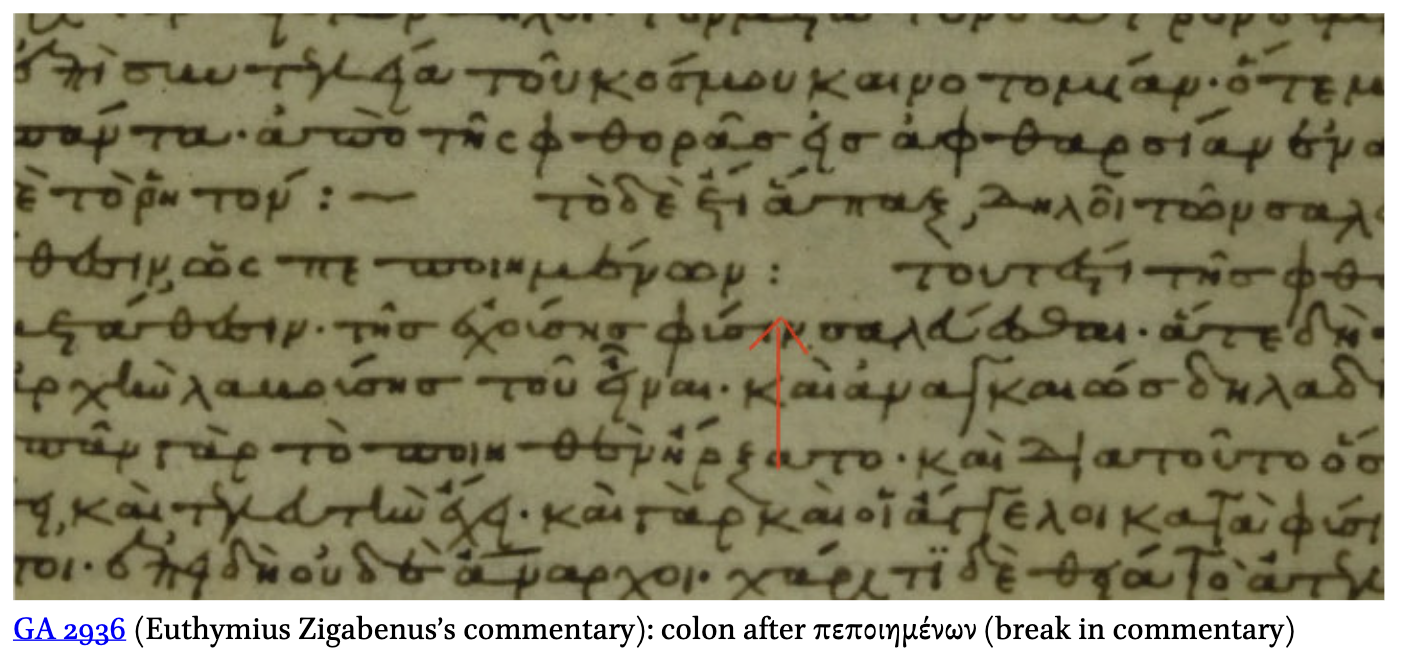
At one point, I got interested in a grammatical question that hadn’t been discussed in scholarship much since the 1800s. I had this idea that if I resurrected the old view I might chart a new path forward on the verse in question. I was reading Bengel’s Gnomon on the Bible (1742) and Grotius’s Annotationes in Novum Testamentum (1641–1650) and Lünemann’s handbook on Hebrew (1882)—stuff that’s old enough that no one cites it anymore. The question was whether two words—ὡς πεποιημένων (“as having been created”)—attach grammatically to the previous or following clause. I talked to a random friend about it who is a Manuscripts Guy during a research library’s coffee break. He wondered if the manuscripts punctuated it, noting that most of our manuscripts of the NT are punctuated (since they’re written later—the original autographs very likely were not). So I looked up the manuscripts and tallied if they added in any punctuation before or after (I found mixed reviews). I wrote up the findings here. It appears that the old view was very unlikely in light of the manuscript evidence. No contribution here.
Now, to be clear, this question I had and the rabbit hole I fell into (my PhD path was a venerable warren) were not the sorts of questions or the sorts of answers that a more senior scholar would have pursued. There was no warrant in current scholarship to pursue the question. Scribal habits just aren’t great evidence to solve the question anyway. My supervisor said to cut all of the resulting material I’d written. Yes, sir.
But as I was looking at manuscripts, one caught my attention. I can’t really read Greek minuscules (cursive used in later Greek—I once saw a unicode font for it with around 1,000 different characters), but I noticed that one of the MSS had surrounding commentary with the words φθορά and ἀφθορά in it—“corruption” and “incorruption” (pictured). This interested me. I tracked down the passage and it turned out to be a commentary by someone I’d never heard of: Euthymius Zigabenus. He was an 11th century Byzantine monk who was a prolific commentator. His interpretation of Hebrews 12:27 made some assumptions about a Greek word that were counter to most modern treatments. For him, the word μετάθεσις meant “transformation,” not “removal.” I then looked at all the church fathers and later Greek interpreters I could find and they appeared to make a similar assumption—though the case wasn’t iron clad. I then did an thorough analysis of μετάθεσις in a corpus of 25 million words plus papyri and inscriptions. Applying cognitive linguistics to lexicography, I demonstrated (in my view) that μετάθεσις cannot mean “removal” which is how it is almost always translated by modern bibles and scholars. “Transformation” is a much better option in context. That led me to a new reading of Hebrews 12:27 that is likely the most significant contribution of my PhD thesis (alongside some stuff about Platonic and Valentinian cosmology).
That is to say, the journey to the new contribution was the opposite of what one could have charted out ahead of time. AI would never have referenced any of the materials that I was interacting with. Indeed, it would have told me it was a poor use of time to look at manuscript punctuation or obsolete monk’s commentaries. I just wonder: if I had been an avid AI user during this time, would I have gotten out of that rabbit hole too soon?
AI can take out what are sometimes considered “low-level” jobs: junior dev, call center worker, data entry, and the uninspiring-level illustrator, designer, cinematographer, writer (esp. writers the “content creation” sort of writers). Manual labor will continue to be safe and sound (though there are not infinite jobs there) for the foreseeable future and the professor and think-tanker roles will still be relevant. The issue with that later is that their jobs are primarily paid for by people who would go to college to get degrees in “computer science,” “graphic design,” “cinema,” “English,” etc.—many of whom did fine, got their Bs, a few Cs, and occasional A, and then went on to be junior devs, do data entry, or were simply not the world’s greatest illustrator, designer, cinematographer, or writer. That is, the people who pay for the profs to do their thing may not consider it worth the cheddar. It just seems like a situation in which there will be less jobs for humans and fewer people going to college for the next few decades. So a likely decrease in both the lower white collar jobs and decrease in demand for professors. Is that right?
In 1 Thessalonians, Paul compares him and his colleagues to infants, nursing mothers (or nurses), and fathers (2:7 [textual variant acknowledged], 8, 11).
Also, Paul says he tried to travel to Thessalonica, but “Satan thwarted us” (2:18)—a situation which all Christians in my circles would have attributed to God’s will. Both can be true, but it’s interesting which the Apostle explicitly cites.
Always nice when you come to the end of a long digression and are struggling to see the connection with the main point when the author spells it out for you: “See my ‘Philo’s Ethical Theory’ (in ANRW, forthcoming).” Ah.