Serendipity and Research
My PhD thesis dealt a lot with Hebrews 12:27. I sent my supervisor around six 10,000 word papers on it, trying and trying again to get it right.
At one point, I got interested in a grammatical question that hadn’t been discussed in scholarship much since the 1800s. I had this idea that if I resurrected the old view I might chart a new path forward on the verse in question. I was reading Bengel’s Gnomon on the Bible (1742) and Grotius’s Annotationes in Novum Testamentum (1641–1650) and Lünemann’s handbook on Hebrew (1882)—stuff that’s old enough that no one cites it anymore. The question was whether two words—ὡς πεποιημένων (“as having been created”)—attach grammatically to the previous or following clause. I talked to a random friend about it who is a Manuscripts Guy during a research library’s coffee break. He wondered if the manuscripts punctuated it, noting that most of our manuscripts of the NT are punctuated (since they’re written later—the original autographs very likely were not). So I looked up the manuscripts and tallied if they added in any punctuation before or after (I found mixed reviews). I wrote up the findings here. It appears that the old view was very unlikely in light of the manuscript evidence. No contribution here.
Now, to be clear, this question I had and the rabbit hole I fell into (my PhD path was a venerable warren) were not the sorts of questions or the sorts of answers that a more senior scholar would have pursued. There was no warrant in current scholarship to pursue the question. Scribal habits just aren’t great evidence to solve the question anyway. My supervisor said to cut all of the resulting material I’d written. Yes, sir.
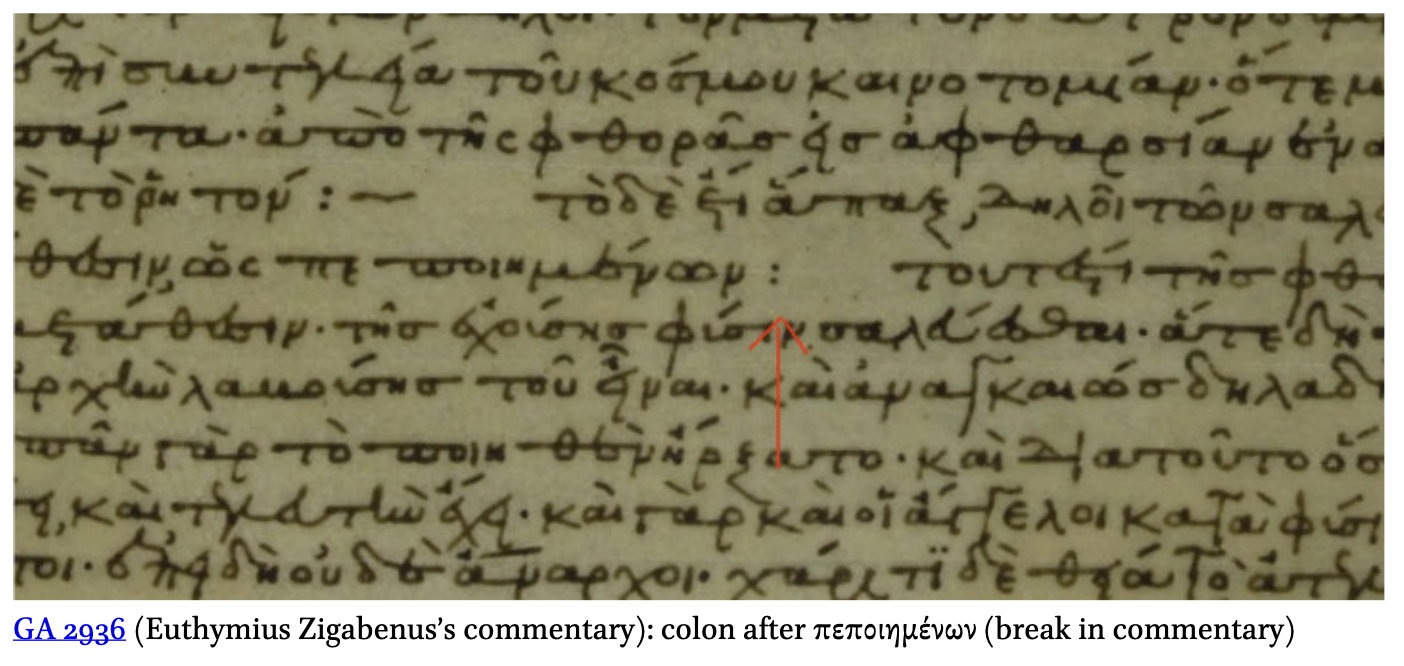
But as I was looking at manuscripts, one caught my attention. I can’t really read Greek minuscules (cursive used in later Greek—I once saw a unicode font for it with around 1,000 different characters), but I noticed that one of the MSS had surrounding commentary with the words φθορά and ἀφθορά in it—“corruption” and “incorruption” (pictured). This interested me. I tracked down the passage and it turned out to be a commentary by someone I’d never heard of: Euthymius Zigabenus. He was an 11th century Byzantine monk who was a prolific commentator. His interpretation of Hebrews 12:27 made some assumptions about a Greek word that were counter to most modern treatments. For him, the word μετάθεσις meant “transformation,” not “removal.” I then looked at all the church fathers and later Greek interpreters I could find and they appeared to make a similar assumption—though the case wasn’t iron clad. I then did an thorough analysis of μετάθεσις in a corpus of 25 million words plus papyri and inscriptions. Applying cognitive linguistics to lexicography, I demonstrated (in my view) that μετάθεσις cannot mean “removal” which is how it is almost always translated by modern bibles and scholars. “Transformation” is a much better option in context. That led me to a new reading of Hebrews 12:27 that is likely the most significant contribution of my PhD thesis (alongside some stuff about Platonic and Valentinian cosmology).
That is to say, the journey to the new contribution was the opposite of what one could have charted out ahead of time. AI would never have referenced any of the materials that I was interacting with. Indeed, it would have told me it was a poor use of time to look at manuscript punctuation or obsolete monk’s commentaries. I just wonder: if I had been an avid AI user during this time, would I have gotten out of that rabbit hole too soon?