
Serendipity and Research
My PhD thesis dealt a lot with Hebrews 12:27. I sent my supervisor around six 10,000 word papers on it, trying and trying again to get it right.
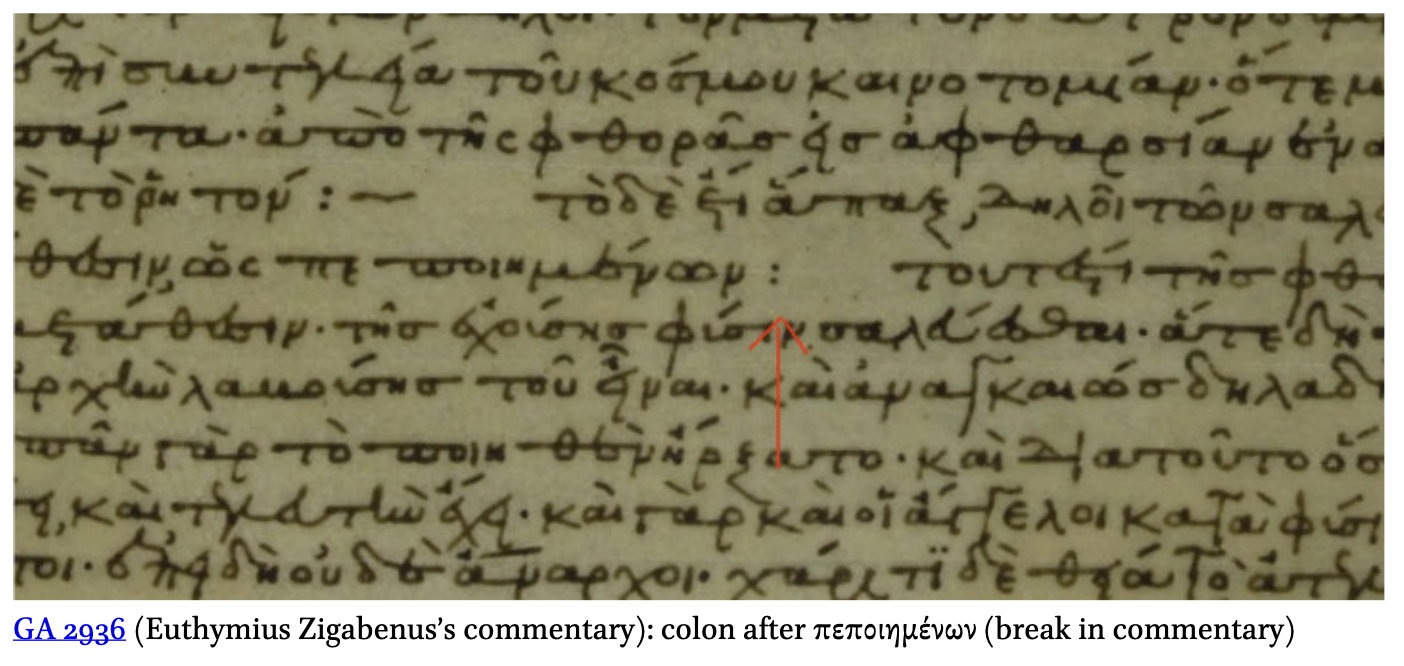
At one point, I got interested in a grammatical question that hadn’t been discussed in scholarship much since the 1800s. I had this idea that if I resurrected the old view I might chart a new path forward on the verse in question. I was reading Bengel’s Gnomon on the Bible (1742) and Grotius’s Annotationes in Novum Testamentum (1641–1650) and Lünemann’s handbook on Hebrew (1882)—stuff that’s old enough that no one cites it anymore. The question was whether two words—ὡς πεποιημένων (“as having been created”)—attach grammatically to the previous or following clause. I talked to a random friend about it who is a Manuscripts Guy during a research library’s coffee break. He wondered if the manuscripts punctuated it, noting that most of our manuscripts of the NT are punctuated (since they’re written later—the original autographs very likely were not). So I looked up the manuscripts and tallied if they added in any punctuation before or after (I found mixed reviews). I wrote up the findings here. It appears that the old view was very unlikely in light of the manuscript evidence. No contribution here.
Now, to be clear, this question I had and the rabbit hole I fell into (my PhD path was a venerable warren) were not the sorts of questions or the sorts of answers that a more senior scholar would have pursued. There was no warrant in current scholarship to pursue the question. Scribal habits just aren’t great evidence to solve the question anyway. My supervisor said to cut all of the resulting material I’d written. Yes, sir.
But as I was looking at manuscripts, one caught my attention. I can’t really read Greek minuscules (cursive used in later Greek—I once saw a unicode font for it with around 1,000 different characters), but I noticed that one of the MSS had surrounding commentary with the words φθορά and ἀφθορά in it—“corruption” and “incorruption” (pictured). This interested me. I tracked down the passage and it turned out to be a commentary by someone I’d never heard of: Euthymius Zigabenus. He was an 11th century Byzantine monk who was a prolific commentator. His interpretation of Hebrews 12:27 made some assumptions about a Greek word that were counter to most modern treatments. For him, the word μετάθεσις meant “transformation,” not “removal.” I then looked at all the church fathers and later Greek interpreters I could find and they appeared to make a similar assumption—though the case wasn’t iron clad. I then did an thorough analysis of μετάθεσις in a corpus of 25 million words plus papyri and inscriptions. Applying cognitive linguistics to lexicography, I demonstrated (in my view) that μετάθεσις cannot mean “removal” which is how it is almost always translated by modern bibles and scholars. “Transformation” is a much better option in context. That led me to a new reading of Hebrews 12:27 that is likely the most significant contribution of my PhD thesis (alongside some stuff about Platonic and Valentinian cosmology).
That is to say, the journey to the new contribution was the opposite of what one could have charted out ahead of time. AI would never have referenced any of the materials that I was interacting with. Indeed, it would have told me it was a poor use of time to look at manuscript punctuation or obsolete monk’s commentaries. I just wonder: if I had been an avid AI user during this time, would I have gotten out of that rabbit hole too soon?
AI can take out what are sometimes considered “low-level” jobs: junior dev, call center worker, data entry, and the uninspiring-level illustrator, designer, cinematographer, writer (esp. writers the “content creation” sort of writers). Manual labor will continue to be safe and sound (though there are not infinite jobs there) for the foreseeable future and the professor and think-tanker roles will still be relevant. The issue with that later is that their jobs are primarily paid for by people who would go to college to get degrees in “computer science,” “graphic design,” “cinema,” “English,” etc.—many of whom did fine, got their Bs, a few Cs, and occasional A, and then went on to be junior devs, do data entry, or were simply not the world’s greatest illustrator, designer, cinematographer, or writer. That is, the people who pay for the profs to do their thing may not consider it worth the cheddar. It just seems like a situation in which there will be less jobs for humans and fewer people going to college for the next few decades. So a likely decrease in both the lower white collar jobs and decrease in demand for professors. Is that right?
In 1 Thessalonians, Paul compares him and his colleagues to infants, nursing mothers (or nurses), and fathers (2:7 [textual variant acknowledged], 8, 11).
Also, Paul says he tried to travel to Thessalonica, but “Satan thwarted us” (2:18)—a situation which all Christians in my circles would have attributed to God’s will. Both can be true, but it’s interesting which the Apostle explicitly cites.
Always nice when you come to the end of a long digression and are struggling to see the connection with the main point when the author spells it out for you: “See my ‘Philo’s Ethical Theory’ (in ANRW, forthcoming).” Ah.
“The real Moon, if you could reach it and survive, would in a deep and deadly sense be just like anywhere else . . . No man would find an abiding strangeness on the Moon unless he were the sort of man who could find it in his own back garden.”
– C. S. Lewis, The Dark Tower and Other Stories, 12
One super interesting thing about Scripture is how sometimes prophecies supply not just the nuts and bolts of what will happen, but the psychological coloring.
In the Gospels:
Luke 9:41 Jesus answered, “You faithless and perverse generation, how much longer must I be with you and bear with you?” Mark 6:5–6 And he could do no deed of power there, except that he laid his hands on a few sick people and cured them. And he was amazed at their unbelief. Mark 8:21 Then he said to them, “Do you not yet understand?” Matt. 13:58 And he did not do many deeds of power there, because of their unbelief. John 14:9 Jesus said to him, “Have I been with you so long, and you still do not know me, Philip?"
This is foreshadowed in Isaiah’s description of the Servant with more emotional poignancy:
Isaiah 49:4 But I said, “I have labored in vain; I have spent my strength for nothing and vanity; yet surely my right is with the Lord, and my recompense with my God.”
That feeling of the futility. Jesus identifies with those days we’re just spinning our wheels.
Read Beautyland by Marie-Helene Bertino
It’s kind of like if Nathan Pyle wrote poetry. Lovely example of defamiliarization as a means of appreciation.
Read Justin W. Jackson, “Shedding the Robes of Kingship: Samuel’s Subtle Imagery and a Surprising Lesson about Israel’s True King” (BBR 34.1: 20–42). Big idea: When David “exposes” himself (2 Sam 6), it isn’t because he’s flashing someone but because he where’s a simple levitical robe (these included undergarments, see Ex 28:42) rather than royal robes (good lexical reasons to read it this way). Michal—a princess—doesn’t approve of him wearing such common clothes. The point is that David (unlike Saul who is stripped in death parallel to Goliath) willingly acknowledges the supremacy of YHWH’s sovereignty. That’s why David says he will become even more contemptible in her eyes. It’s all about who the true king is.
If you like this sort of thing, I wrote a sartorial reading of 1 Samuel a little while back.
2 AI things coming:
- Bespoke spam emails based on webscraping your acquaintances/coworkers. Maybe not dupe-worthy, but more likely to take time to deal with.
- Upload a picture of you and someone (coworker, friend)—generate bespoke video porn. Age/ethnicity/etc. adjustable on request. Terrifying.
Not yet had the pine-tree, felled on its native mountains, descended thence into the watery plain to visit other lands; men knew no shores except their own.
– Ovid, Metamorphoses I
The Peters’s elephantnose fish has a nose-like thing called a Schnauzenorgan. It uses electricity to explore its surroundings. What a world.

“You do yours and the Holy One blessed be He will do His.”
Adam’s natalist argument from Bereshit Rabbah 23.4
Seeing Motes
At first it’s skating across a pool of milk
crossing rivers of blood slowly divesting
then back and forth back and forth
oblique and bashful yet
always hoping to wander through that
rainbow of fire and ice
to the unseeable center:
a black hole,
a substantial absence,
in whose depths lies
a world upside down
reflecting behind its own suspended soul.
‘Behold, William, in a few words I have described the form of living. If you wish to follow it, without doubt you will attain great perfection. And, when it has been well for you, remember me, who spurred you on (to the extent that I could) so that it would turn out well for you.’
Learned that there’s a Gnostic church still going.
Waltzing Matilda + Overtone Singing by the brilliant Bukhu Ganburged.