Grokipedia and Wikipedia
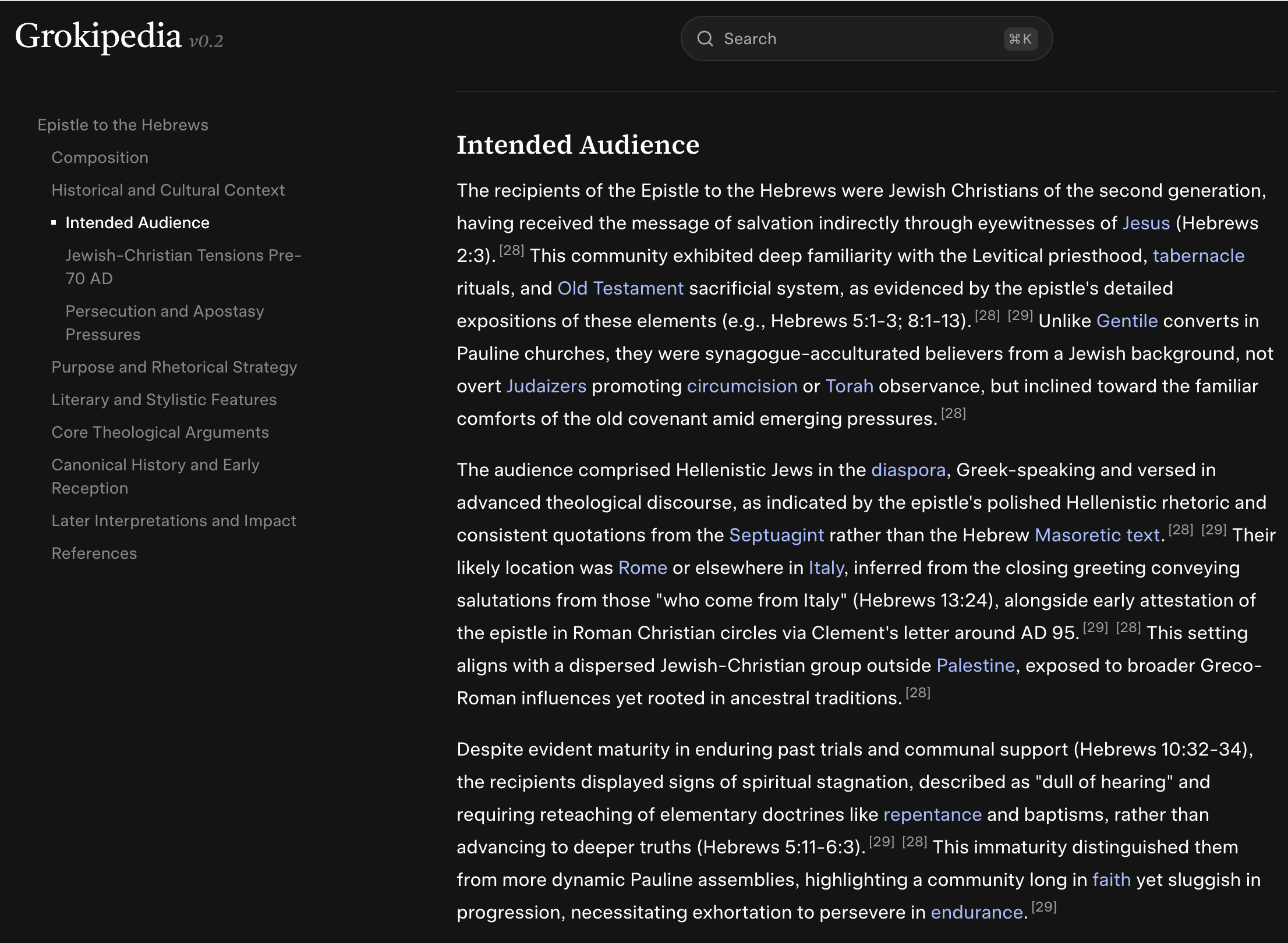
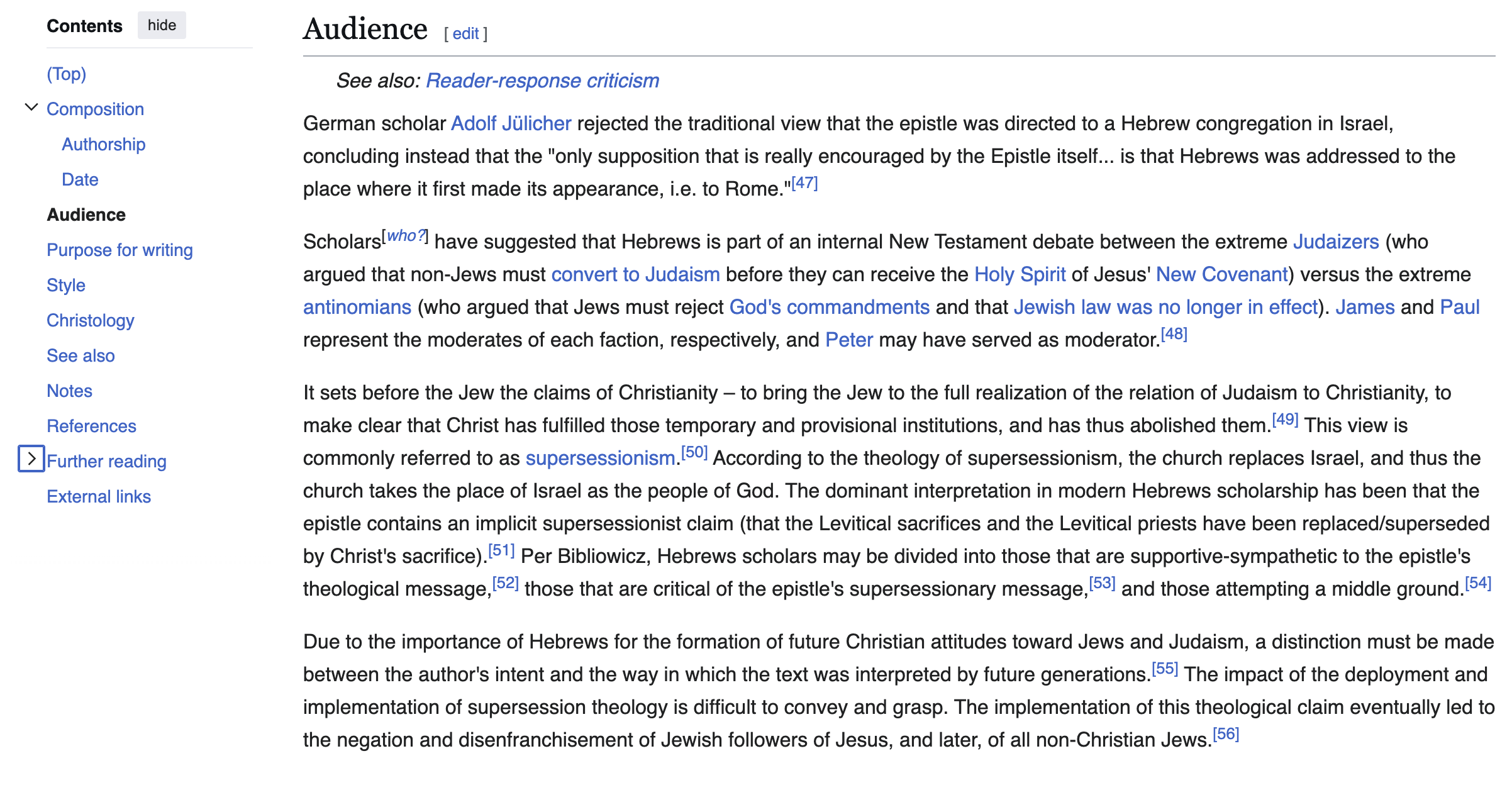
Found my way for the first time onto Grokipedia—an LLM aping Wikipedia with longish organized entries on all sorts of topics. Comparing the entries on “The Epistle to the Hebrews” brings out some of the differences in how a robot brings together mass amounts of info and how a few concerned citizens on Wikipedia do. A few observations on the “audience” sections in no particular order:
1 Structure
The AI version is far more readable. The structure is clear and topic sentences signal the paragraph content. It is far more cohesive and progresses logically. The Wikipedia version starts with a rando quote from a 1904 book by a German scholar I’ve never heard of on a book not specifically about the Epistle to the Hebrews. Odd.
2 Citations
Grokipedia cites sources at more consistent intervals, but they are all from the same two sources: ThirdMill (think John Frame and co.) and The Gospel Coalition. Only two sources, on repeat, both from a reformed evangelical perspective. Super narrow. (In general, I find LLMs to echo the views of reformed evangelicals on biblical studies topics—most likely because they are a far more online tribe than other denominations with the strongest Meme game. When I visit Catholic websites, I can sometimes see the HTML bleeding through in the background. Orthodox similarly.) Wikipedia’s sources are weird and spotty—a recent Journal of Biblical Literature article (through from a perspective that tilts strongly towards one side on the issue of audience and the letter’s purpose), random books about the NT, some stuff about Jewish-Christian relations. It’s all a bit slapdash. Neither resource is hitting the main scholarly players. None cites ANY BOOKS SPECIFICALLY ABOUT THE LETTER TO THE HEBREWS, of which hundreds exist.
3 Integration of Sources
Grokipedia doesn’t quote anyone—it maintains its authoritative voice throughout and gives you footnotes that leave the impression of ‘research’—again, to two popular-level, supped-up blogs from a decided perspective. Wikipedia has a few (not many) references to real people who think and say things (Adolf Jülicher, Abel Bibliowicz). It also includes something an AI never would: a parenthetical that calls an assertion into question (“Scholars [who?] have suggested”). This is almost certainly an automated feature on Wikipedia’s part—the function of something not so unlike AI—but it casts doubt onto what’s written.
The overall impression one gets from the two sources: the Grok version is far more “useful” (or better: “usable”) but far more misleading. Reading the Wikipedia article immediately informs you that you are interacting with a perspective (or a few of them), while Grok speaks with timeless authority. But the Wikipedia article does not give you a good look at the state of discussion either.
A question: how could these tools be integrated together to improve each other? I wonder about Grokipedia (which deep down I hope will die but I know that’s prolly unlikely) could automatically request experts in the field on its various topics to take the role of official editor? The problem is that old views long-debunked in the academy keep being propagated on such popular level resources. Unfortunately, there is also less impulse in the academy to do the actual work of making information broadly accessible (lip service to the “trickle down” effect is much easier than devoting a few hours on a Saturday afternoon to editing a Wikipedia page someone might ruin later). Right now, the two separate entities don’t cross paths. Perhaps that’s best (or safest). But perhaps there is potential for something organized, readable, but that couches topics in a more human-level of certainty.